|
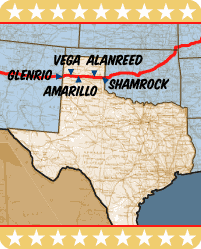 As the average Route 66 motorist reached the "Panhandle" in the Lone Star State, it became obvious that a profound change was occurring. The traveler could clearly see that he had left the Midwest behind and had begun to enter the more wide open spaces of the far west.
Many a westward voyager would stop in one of the small towns such as Shamrock, McLean, Adrian or Vega for gas, food or service. Perhaps the traveler might have noticed that the air had different, drier scent to it accentuated by the fragrance of scattered cedar trees.
Several fascinating tourist establishments were or still are located in the Panhandle. The Cadillac Ranch, the Barbed Wire Museum, The U Drop Inn or the Rattlesnake Ranch come to mind.
Amarillo was always a good place to stop for a night's lodging with the "main drag" lined with numerous motels and dining establishments. If a traveler is hungry for good food, the world famous Big Texan Steak Ranch in Amarillo should not be passed up.
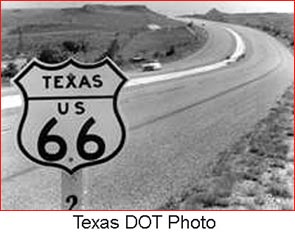
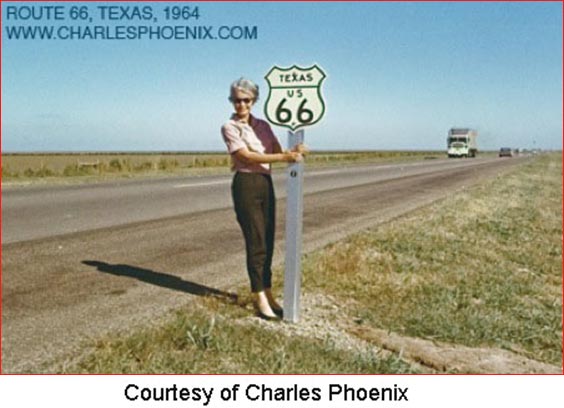
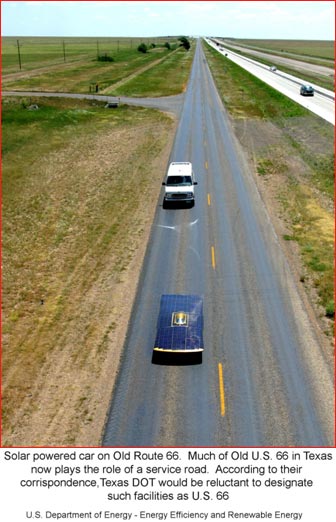 In the interest of continuity to the Route 66 traveler, The Lone Star State makes a good case for restoring the U.S. 66 designation. For one thing, at the present time (2012), the State of Texas does not participate in the National Scenic Byway program yet travelers on Route 66 still need route markers to keep them on course.
The U.S. Route 66 Recommissioning Initiative had a correspondence with a TEXDOT official in which we were informed that much of Old Route 66 has either been covered over by Interstate 40 or relegated to the role of service roads. However, it was hinted that they might be open to the idea of co-designating U.S. 66 with I-40. The issue is how to pay for the signs.
The Initiative advocates the placement of U.S. 66 markers on Interstate highways in the event that no historic alignment is available to carry the designation. Placing U.S. 66 markers on an Interstate is also appropriate in those locations where old U.S. 66 once shared the alignment with an Interstate facility. Such is surely the case in the Texas Panhandle.
However, the historic alignment of Old Route 66 is available in Amarillo, Vega and Shamrock and possibly in a couple of other communities as well. These communities and their associated businesses would especially benefit from a new U.S. Route 66 in their business districts.
New U.S. Route designation would also improve signage across the state, return the Route to all standard road atlases and provide the historic Route 66 traveler with a consistent, continuous state-to-state marking plan.
 If you are a resident of the great Lone Star State, contact your state representatives at: http://www.fyi.legis.state.tx.us/
Ask them to consider sponsoring legislation that would 1) restore the U.S. Highway designation to Old Texas Route 66 and 2) amend Texas law to allow the State to participate in the Scenic Byway program.
The United States Congress also has the authority to designate or re-designate U.S. Highways. E-mail or write your U.S. Representative at: www.house.gov/writerep/
Let your U.S. representative know that a new official U.S. Route designation is needed for Old Route 66 and that federal assistance is needed to help pay for additional new signs and, where needed, repairing the old roadway and bridges.
Better yet, Senator Kay Hutchison in a ranking member on the Senate Transportation Committee and might be in an optimal position to help. Contact Senator Hutchison at: http://hutchison.senate.gov/?p=email_kay
It might also be helpful to let the Texas D.O.T. know that more and better signs are needed for Old Route 66, possibly through a new U.S. Route designation. The more people they hear from, the better the chances that they will address issues directly related to Route 66. Contact them at: http://www.dot.state.tx.us/contact_us/form/
|